
PACT Interviews and Workshops
Gain practical skills and learn new approaches that help you and your clients grow and thrive — even if you have not taken PACT training.
Open to all clinicians, these interviews and workshops are chock-full of useful information vital to your ongoing growth and development as a couple therapist.
If you have a PACTplus: Alumni Community Membership, these interviews and workshops are included in your membership. Please sign up in advance in your PACTplus portal for these events at no additional cost.
If you are not a PACTplus: Alumni Member, you can still register and join in! Simply sign up for each workshop using the links below.
Interviews
Join PACT developer Dr. Stan Tatkin as he interviews other experts in the field of couple therapy and delves deeper into topics related to sex issues, consensual non-monogamy, and the integration of PACT with other models of couple therapy.
In these interviews, you’ll meet a range of innovative and inspiring people who are working with couples in their own ways.
Workshops
In workshops, you’ll learn from PACT founder and other PACT faculty about experiential strategies, pioneering approaches, and practical resources that allow you to integrate new skills into everyday clinical practice and feel more confident in your work with couples.
Upcoming Events
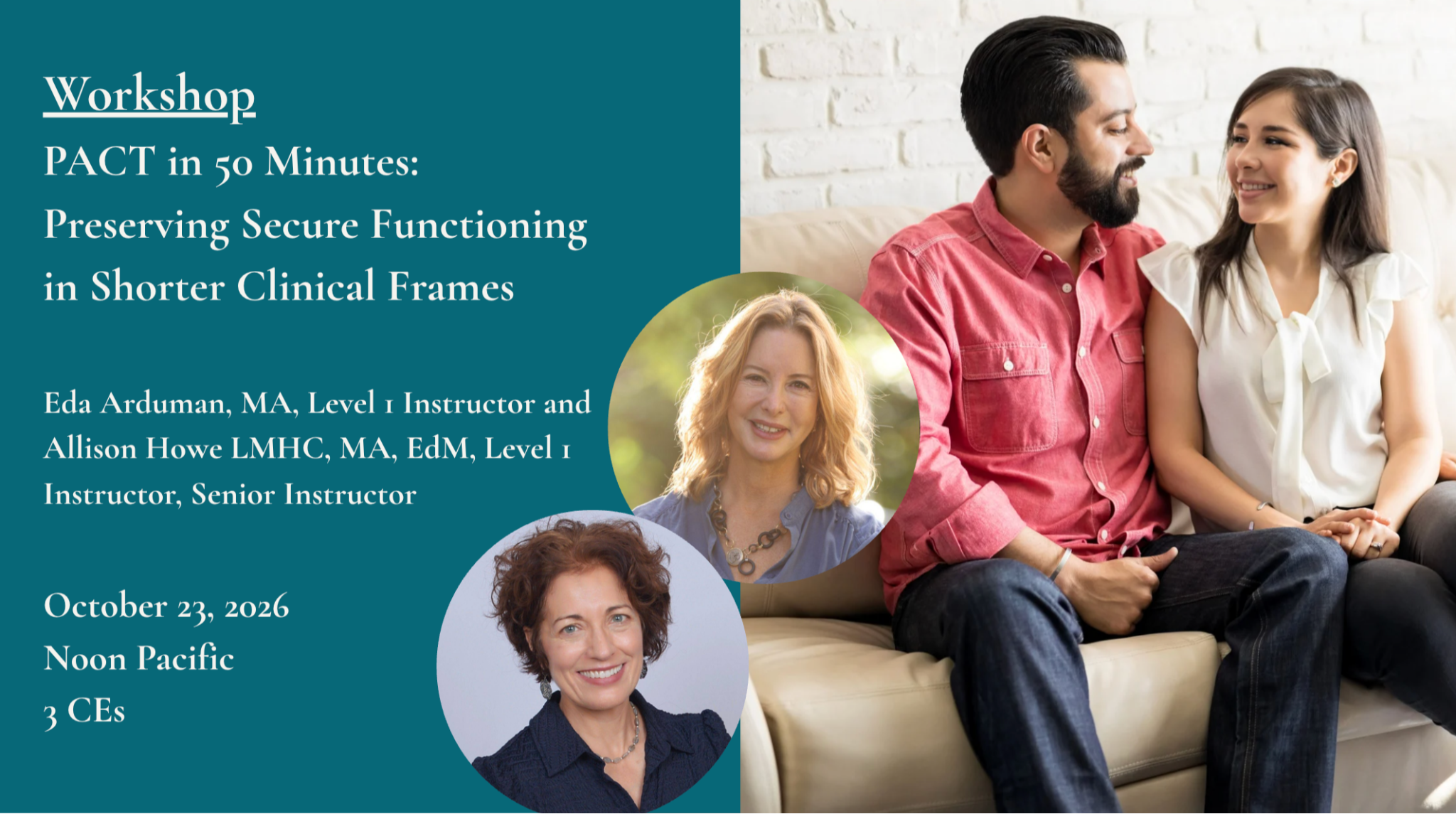
Live Workshop | PACT in 50 Minutes: Preserving Secure Functioning in Shorter Clinical Frames by Eda Arduman, MA, Level 1 Instructor and Allison Howe LMHC, MA, EdM, Level 1 Instructor, Senior Instructor
October 23, 2026, 12:00 noon – 2:30pm Pacific Time
At the PACT Institute, we get one question from clinicians more than any other: Can I do PACT in a standard 50-minute session? The answer is YES. Seasoned PACT cliniciians and PACT Level 1 Instructors Eda Arduman, MA, and Allison Howe, LMHC, MA, EdM, are going to show you how. This workshop will help licensed clinicians, all aspiring PACT trainees, and any couple therapist hoping to increase their imPACT in a brief format.
PACT was designed within a 90–100 minute clinical frame, allowing time for live enactments, micro-analysis, and regulatory interventions. However, many clinicians work in systems that require 50-minute sessions. The question becomes: How do we preserve secure functioning principles, moment-to-moment tracking, and down-the-middle positioning without diluting the model?
This innovative and practical 2.5 hour workshop gives you the ability to become more selective and precise by choosing one meaningful issue and one clear intervention so fidelity to the PACT model gets sharper, not thinner, when the clock is short.
Eda and Allison will teach the same organizing sequence they use live in their own sessions:
- LAND: Settle three nervous systems. Establish a joint mission.
- PLANT A FLAG: Choose one consequential pattern, task, or repair.
- INTERVENE: Engage, test, and observe.
- LAUNCH: Consolidate the learning and agree on one shared practice.
Both Eda and Allison present a real-life case as an example, demonstrating how to establish a shared task immediately, orient couples toward governance, and use rapid enactments and cross-tracking to assess attachment style, arousal regulation, developmental injury, and threat perception.
You’ll be able to see how they integrate current interpersonal neurobiology research with secure-functioning principles, emphasizing how shorter sessions require greater clarity of therapist stance, sharper tracking of nonverbal behavior, and disciplined time management.
Across two case presentations, you'll observe this sequence at work with two different therapists working with two different couples, two different issues, two different interventions — and see what holds steady underneath: the therapist observing, cross-questioning, mentalizing, corroborating, and protecting both partners as they move toward secure functioning.
Your Workshop Takeaways
Learn how to structure your PACT session into four distinct phases.
- Land: Assess the couple in the first minutes.
- Plant Your Flag: Determine what you will focus on.
- Intervene: Stay on task while moving the couple toward secure functioning.
- Launch: Close sessions strategically by consolidating learning and reinforcing secure functioning.
Regardless of your session length, this workshop will help clinicians plan more precisely and get more clear results from every couple session.
After you register…
Watch your inbox in the days and hours before the workshop for your Zoom link!
Can’t make it live?
Purchase in advance to receive access to the workshop recording for three months. The recording is available only if you register before the live event begins!
Plus These Great Benefits!
- CE credit is available for this workshop.
- No PACT training is required to attend.
- Become a PACTplus: Alumni Community member to reserve your seat for free.